
[Previous article] I visited Chita Distillery. (Part 1) January 26, 2016
Chita, the name of the grain whisky released by Suntory in September 2015.
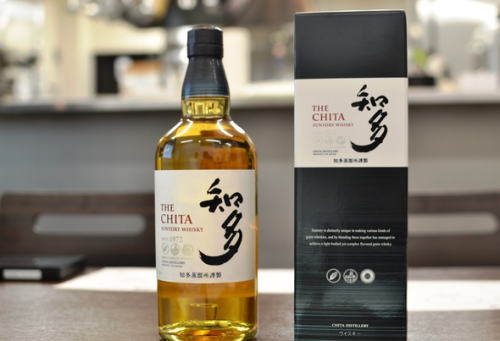
A whisky made from 100% grain is rare, and this is Suntory's first such product.
The more you learn about Chita, the deeper its appeal becomes.
To convey the charm of Chita to all of you,
we must study hard!

So, I went to Suntory Chita Distillery on the Chita Peninsula in Aichi Prefecture!
After getting off the shinkansen, we transferred to a chartered bus and headed to our destination!
But what kind of place is the Chita Distillery?
When Chita arrived at the store, I couldn't quite picture the distillery.
I wondered if it was similar to the Yamazaki or Hakushu distilleries.
However, as the estimated arrival time approached, we entered an industrial area.
I began to feel a little uneasy, wondering if there was a distillery in such a place...
Just when I thought "no way," the bus stopped.
Oh, what?! Something's different!

The place we arrived at was indeed an industrial area.
Oh, the driver messed up. Made a mistake.
Well, these things happen (lol).
Still, we were dropped off the bus.
Then, the moment we stepped outside, a wonderfully fragrant aroma filled our bodies.
That aroma was definitely corn! It's easy to understand if I say it smelled like popcorn.
All my previous anxiety disappeared, replaced by exciting anticipation!
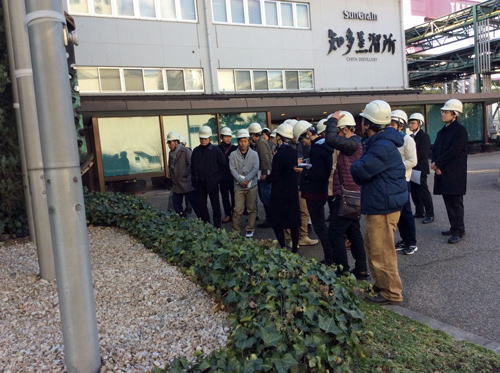
And in front of us, the five characters "Chita Distillery".
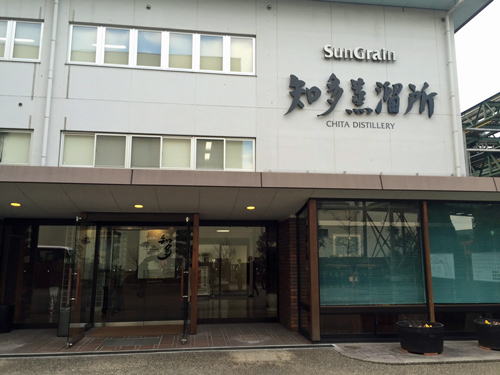
It's definitely the Chita Distillery! Driver, I apologize...
This distillery does not usually accept visitors, but
this time, they made an extra special exception to guide us from Sumidaya.
Before I tell you about the charm of Chita, here's a little information about the distillery.
The Chita Distillery was established in 1972 in Chita, Aichi Prefecture.
While the Yamazaki Distillery (Osaka, established 1923) and the Hakushu Distillery (Yamanashi, established 1973) produce malt whisky,
the Chita Distillery here
produces grain whisky
using corn and other grains as raw materials.
(Hakushu also produces a small amount of grain.)
The grain whisky produced here is
blended into Suntory's flagship products such as Hibiki and
Kakubin.
This is Ms. Nomura, who will guide us through the Chita Distillery this time.
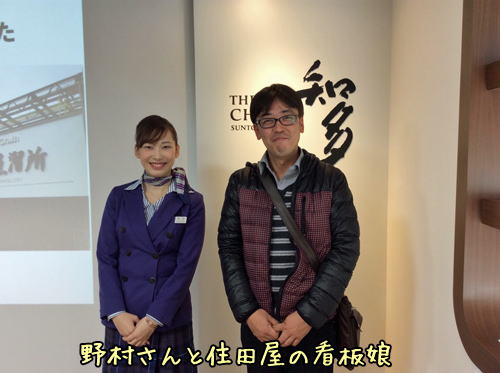
She has a refined, beautiful, and dignified aura.
Pyonkichi was smitten.
One of the distinctive features of the Chita Distillery is its stills.
Continuous stills are used to produce grain whisky.
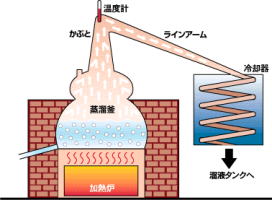
About continuous stills and pot stills:
★What is a continuous still?It involves feeding the mash into the top of the mash column
while simultaneously introducing steam from the bottom upwards.
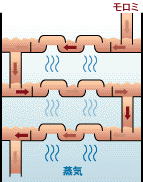
Then, the volatile components in the mash, heated by this steam, are extracted,
cooled, and returned to a distillate.
To match the characteristics of the corn, it is distilled to a very high concentration (94 degrees), so it has fewer flavor components and no strong taste.
It smooths the palate and softens the strong characteristics of malt whisky.
★What is a pot still? It is the simplest distillation method, performed using a still composed of three parts:
a "pot" for heating and evaporating the distillation raw liquid (mash),
a "condenser" for condensing the steam, and a "line arm" connecting the two.
It is used for malt whisky in Japan and Scotland, and for whisky in Ireland.
The continuous still at the Chita Distillery is a multi-type still capable of producing three types of grain whisky, and this is truly unique!
It is an extremely rare continuous still, found only at Suntory in the world.
Do you even know what grain whisky is?
I was clueless due to my lack of knowledge, but
Ms. Nomura explained it to me very clearly.

"The main ingredients of grain whisky are corn, wheat, rye, and other grains.
A small amount of barley malt is added for saccharification, then it's fermented and distilled in a continuous still.
This is how grain whisky is made.
It is characterized by its smooth, mild taste, without any strong flavors.
Grain whisky plays a role in bringing out the individuality of malt whisky and creating a smooth, pleasant taste.
To use a culinary analogy, it's like the dashi (broth) that is essential to Japanese cuisine."
I used to think of grain as just a supporting role for malt, but when I heard this,
I realized that it's actually the key to the flavor!

Thank you, Ms. Nomura, thank you to everyone at Suntory,
and thank you, Chita Distillery!!
You must be even more curious about the Chita Distillery, which plays such an important role, right?
Now, let's look at how the Chita Distillery's grain whisky is produced.
Suntory's proud, world-rare multi-type continuous still!
We listened to the explanation while looking at a model.
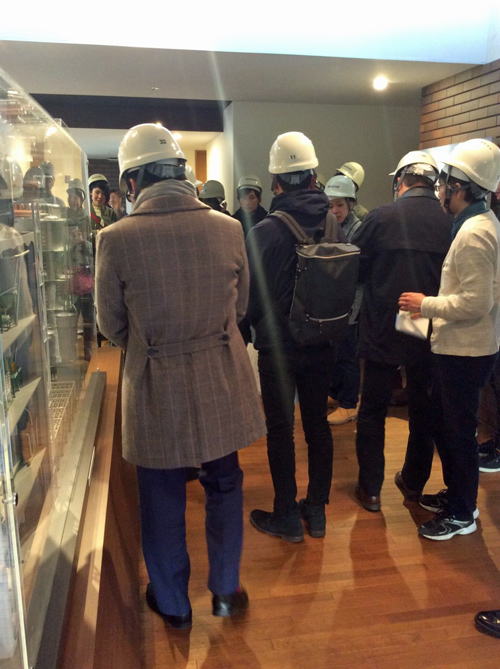
The raw materials for the whisky produced here in Chita are corn and only the malt used for fermentation.
First, this corn is steamed and a small amount of malt is added for saccharification.
This results in an alcohol-free corn soup.
Yeast is then added, and it is fermented for 3-4 days.
By the way, there is currently a 24-hour system where one tank's worth of liquid flows through long pipes.
Three types of new make spirit are produced from the still: heavy, medium, and light (clean).
Now, it's time for the still to shine.
For the heavy type, a two-column still is used, with distillation first in the mash column.
This produces new pot (new spirit) with an alcohol content of 94%.
This new make spirit has a rich, grain-like aroma reminiscent of bonito flakes.
Next, for the medium type, a three-column still is used.
Alcohol that reached 80% in the mash column is watered down to 20%.
It is then put into an extraction column to remove unnecessary aromas, and then rectified in a rectification column to 94% alcohol content.
A mild, grain-scented, well-balanced new make spirit is completed.
And for the light type, a four-column still is used.
Distillation takes place in the mash column, extraction column, and purification column, and the 94% distilled spirit is sent to the rectification column.
Here, only the necessary alcohol and flavors are extracted.
This is how a truly light and clean type of new make spirit is completed.
To see the actual stills, we moved outdoors.
We moved while inhaling the sweet and fragrant aroma of corn to our heart's content.
Ms. Nomura began her explanation in front of what looked like an objet d'art.
Listening to her, I learned that they are exhibiting a rectification column cut in half.
It wasn't an objet d'art after all...
Of the four columns, only the rectification column has a copper interior.
Copper has the effect of removing sulfur components generated during distillation,
and copper ions are generated when alcohol comes into contact with it.
These copper ions are also said to remove unwanted components and refine the alcohol.
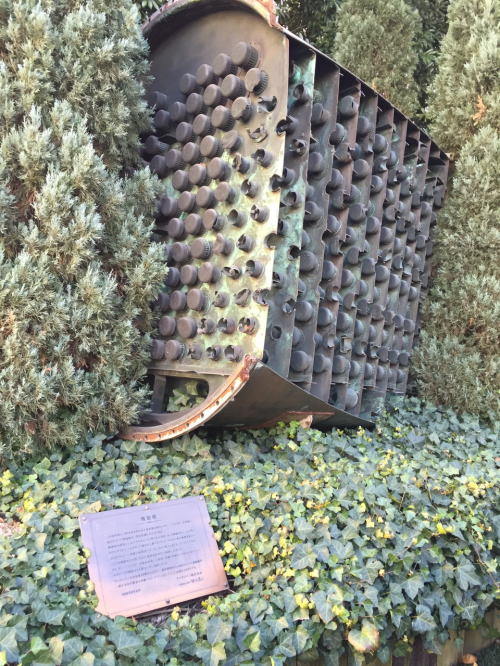
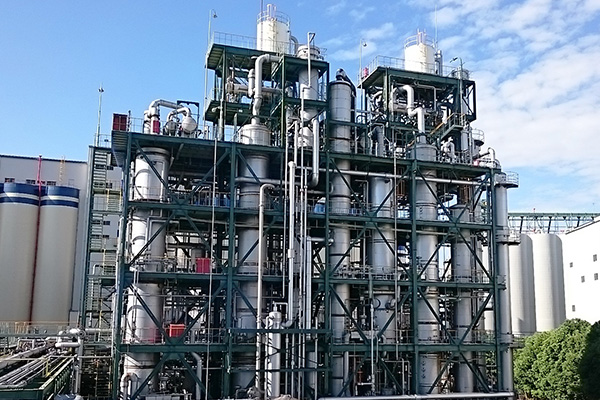
Next, we finally get to see the actual continuous still!
As we moved, we immediately noticed that it was completely different from the distilleries we had visited so far.
At Yamazaki and Hakushu, there's dappled sunlight through the trees, giving a sense of nature.
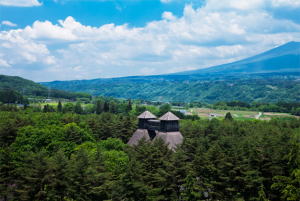
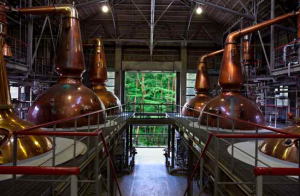
Pot stills gleaming in golden light.
New make spirits, filled into barrels, slowly fall asleep.
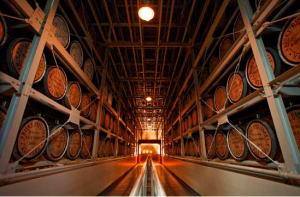
For us, it was like a theme park.
However, this Chita Distillery is different!

Wow, a silver world all around!
No, I don't mean a snowy landscape.
There are various pipes, tanks, and equipment of different sizes, but
almost all of them are silver (lol).
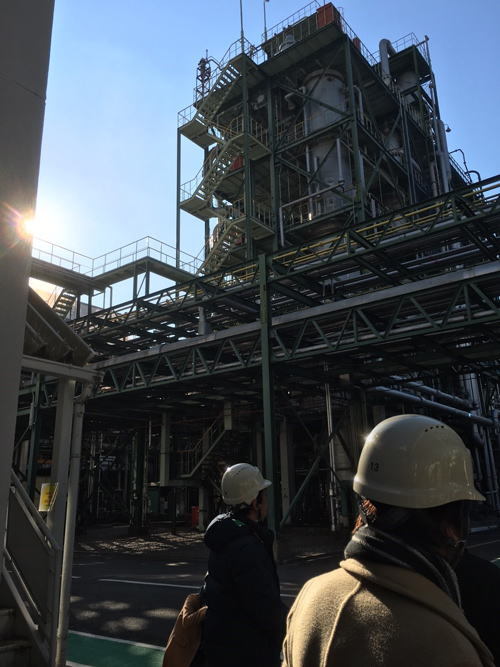
Is unaged whiskey flowing through these pipes?
I wondered if it tasted good... While everyone listened intently to Ms. Nomura's
explanation, I was seriously daydreaming.
At the same time, I thought, "I want to taste Chita soon!"
Ms. Nomura, I'm sorry for being disrespectful.
Needless to say, we don't want to go to a theme park!
Tightening the chin strap of my helmet, I pushed forward along the not-so-wide designated path
to where real grain whisky is born:
the continuous still!
Everyone stopped in their tracks, and what appeared before us was the mash column we saw in the model!
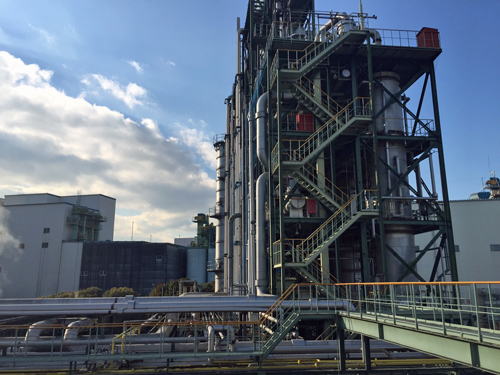
So this is a continuous still!
Its sheer size is overwhelming.
This is the extraction column, that's the rectification column, and that's the purification column...
Ouch... Ouch.
My neck hurts.
It's really big, so looking up at it for too long makes my neck hurt.
From the outside, I can't tell what it's like inside at all,
but I can only imagine it, recalling the explanation I just heard.
Next, we move to the roof of the building.
On the way, we got to see an aerial photograph of the Chita Distillery.
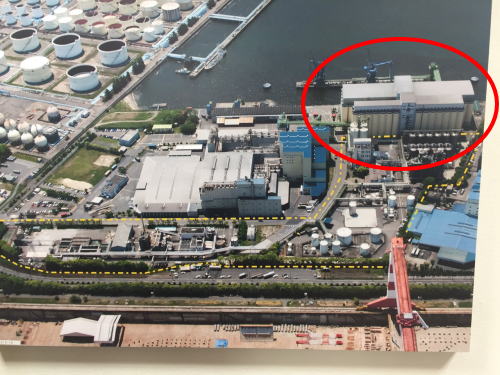
Located near the sea, JA's massive silos stand between the port and the distillery.
The corn, which is the raw material, is transported from the tanker that arrives at the port to the JA silos,
and there's a system in place to transfer it directly from those silos to the distillery's silos.
The site, about 2.5 times the size of Nagoya Dome, used to have railway tracks for transportation when it was first established.
This concludes Part 1, to be continued in Part 2



Leave a comment